
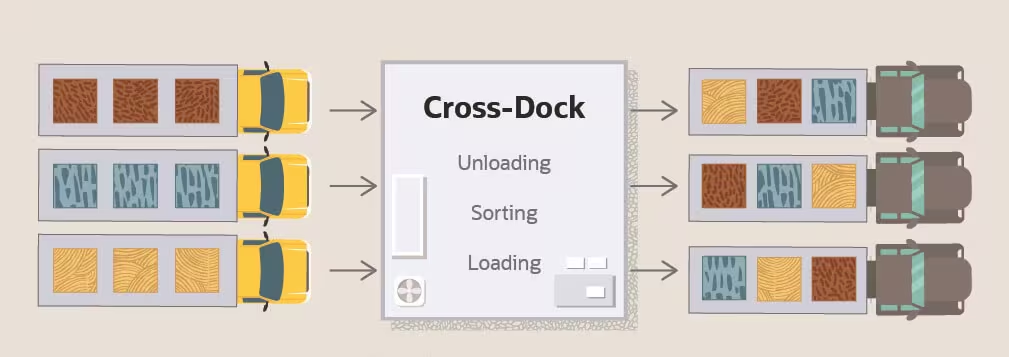
In a supply chain where speed and cost efficiency determine competitive advantage, cross-docking has emerged as one of the most powerful and most underutilized tools available to importers, exporters, and domestic shippers. According to the Bureau of Transportation Statistics, inefficient warehousing and distribution models cost U.S. businesses hundreds of billions annually — much of it recoverable through smarter facility operations. By eliminating or dramatically reducing the storage phase between inbound and outbound freight, cross-docking compresses transit timelines and strips out warehousing costs that most businesses accept as unavoidable.
This guide explains exactly how cross-docking works, where it delivers the most value, and how businesses working with a reliable freight forwarder and 3PL logistics partner can integrate it into their supply chain management strategy for maximum impact.
Cross-docking is a warehousing services USA practice in which inbound freight is unloaded from an incoming carrier, sorted or consolidated at a transfer facility, and loaded directly onto outbound vehicles with minimal or zero storage time in between. The freight moves through the facility rather than sitting in it.
The concept applies across every mode of transportation. Ocean container freight arriving at a Gulf Coast port can be cross-docked through a transloading facility into domestic trucks. Air cargo arriving on international flights can be sorted and re-manifested for less-than-truckload (LTL) forwarding delivery to multiple regional destinations. The International Chamber of Commerce recognizes cross-docking as a globally accepted best practice for reducing supply chain friction in high-velocity distribution environments. Domestic full truckload (FTL) shipping can be broken down and reassembled for more efficient regional distribution.
Eliminating Storage Wait Time
In a traditional warehousing model, inbound freight is received, logged into inventory management systems, placed in storage, and retrieved when an outbound order is processed. Each step adds time. For businesses managing international cargo management across multiple origins and destinations, those accumulated delays can add days or weeks to end-to-end transit time.
Cross-docking eliminates the storage phase entirely for qualifying freight. Inbound containers arriving via ocean container forwarding through ports like New Orleans, Houston, or Savannah — or via air cargo forwarding on time-sensitive shipments — move directly from receiving to outbound loading. The result is a transit timeline measured in hours rather than the days that warehouse dwell adds to traditional distribution.
Optimizing Outbound Load Consolidation
One of the most significant time savings from cross-docking comes from outbound load optimization. Rather than waiting for a full truckload of product destined for a single customer, cross-dock facilities consolidate freight by destination zone — combining shipments from multiple sources into optimized outbound loads that cover more destinations per truck.
This freight consolidation approach reduces the number of individual shipments in the network, compresses last-mile delivery timelines, and eliminates the coordination delays that come from managing multiple separate delivery windows. For businesses distributing product across multiple regional markets, the time compression is substantial.
Faster Response to Time-Sensitive Freight
For time-sensitive air freight and expedited shipments, cross-docking is often the only warehousing model that preserves the speed advantage of air transport through to final delivery. An express air shipping shipment that arrives quickly but sits in a warehouse for 48 hours before being processed loses the speed premium entirely. Cross-docking maintains that speed advantage through the final distribution leg.
Eliminating Storage and Handling Costs
Traditional warehousing involves multiple cost layers: pallet storage solutions fees, pick and pack services labor, inventory management solutions overhead, and the carrying cost of capital tied up in stationary inventory. Cross-docking eliminates or dramatically reduces all of these by keeping freight in motion.
For businesses currently paying for storage on freight that moves predictably and regularly, cross-docking converts fixed storage costs into variable handling costs — a structure that typically produces significant savings at moderate to high freight volumes.
Reducing Labor Touchpoints and Damage Risk
Every time freight is moved, labeled, scanned, staged, and stored, labor costs accumulate. A traditional receive-store-retrieve-ship cycle involves four to six distinct handling events per shipment. Cross-docking compresses that to two — receive and ship — dramatically reducing the labor cost per unit moved through the facility.
Fewer handling touchpoints also mean lower freight damage rates. The FMCSA carrier safety framework recognizes handling frequency as a key variable in cargo damage claims. This is particularly relevant for businesses managing perishable goods logistics, medical equipment logistics, or automotive parts shipping where product integrity is critical and damage claims are expensive.
Optimizing Transportation Costs Through Consolidation
Freight deconsolidation and reconsolidation at cross-dock facilities allows businesses to optimize outbound load factors — sending fuller trucks to more destinations per run. For businesses receiving LCL shipping or FCL shipping containers from international origins and distributing domestically, cargo transloading at a cross-dock facility near the port of entry allows immediate conversion into optimized domestic loads.
Per U.S. Customs and Border Protection import guidelines, swift movement from port to distribution facility also reduces the risk of per-diem container charges and customs holds — both of which are expensive disruptions that cross-docking infrastructure near port facilities helps prevent.
Cross-docking is not universally superior to traditional warehousing. It delivers maximum value in specific supply chain contexts:
The most effective cross-docking implementations are integrated components of a broader end-to-end logistics solutions strategy. For businesses receiving international freight through New Orleans freight forwarder services or Houston freight forwarding operations, coordinating customs clearance, port pickup, transloading, and outbound distribution through a single international logistics partner eliminates the coordination gaps that defeat the speed advantage cross-docking creates.
BMI Shipping’s warehousing and consolidation capabilities combined with our comprehensive transport management across ocean, air, and domestic trucking provide the infrastructure for cross-docking programs that work as part of a coordinated logistics system. Contact our team at bmishipping.com/contact-us or call our New Orleans office at 504-467-4220.


